
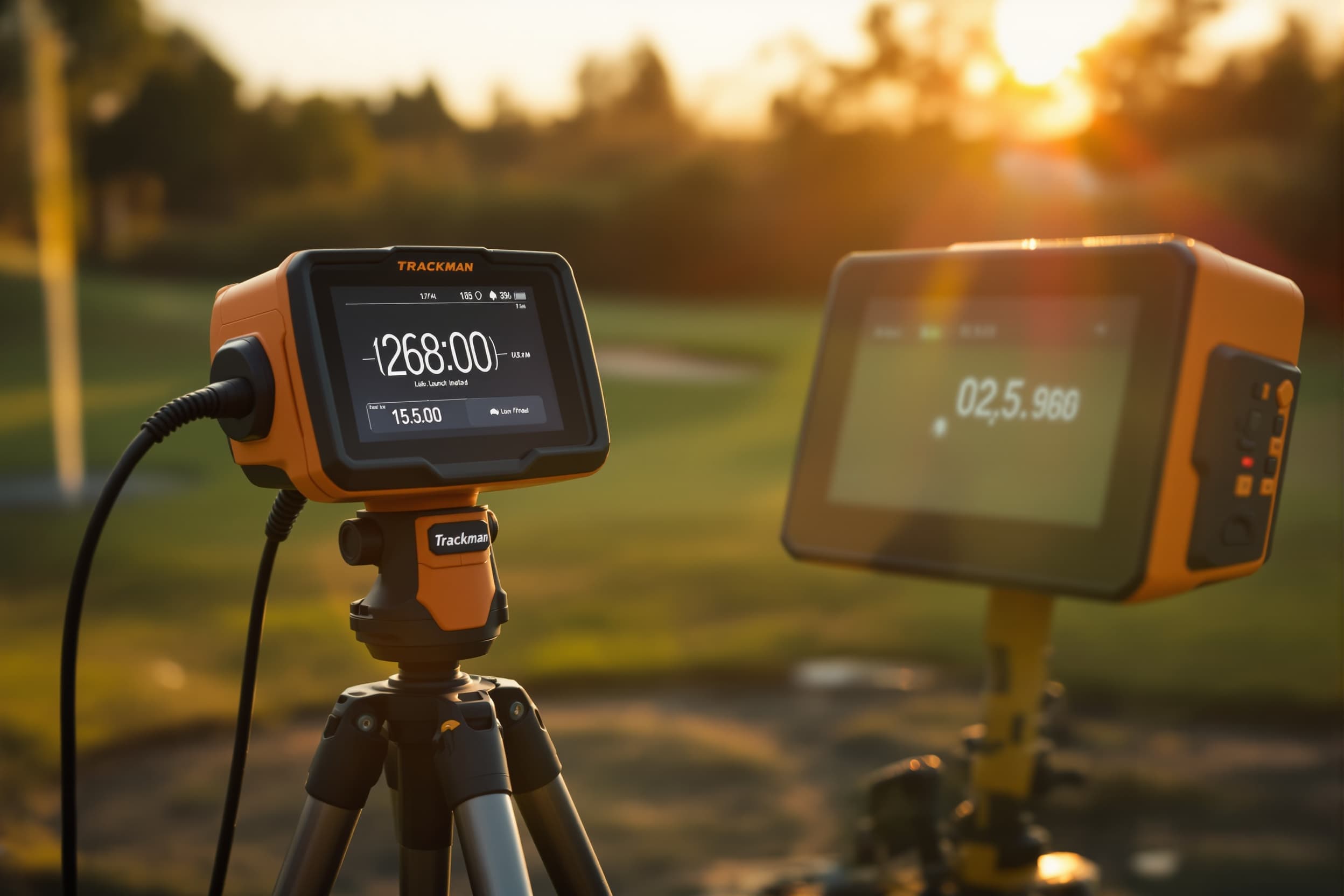
Trackman captures more data on a single golf shot than most tour pros looked at in their entire careers thirty years ago. Ball speed, club head speed, smash factor, attack angle, dynamic loft, spin axis, spin rate, launch angle, carry, total, dispersion left/right, height, descent angle, roll. It's overwhelming.
For the average golfer being fit, only four of those metrics actually matter. The rest are interesting but not actionable.
1. Smash factor.
This is ball speed divided by club head speed. The closer to 1.50 on a driver (and 1.30-1.40 on irons), the better your contact. If smash is low, you're hitting the ball off-center. A better fit head (one with a more forgiving face) often improves smash by 0.03-0.05. That's 5-10 yards of carry without any swing change.
2. Spin rate.
Too high (above 3,500 RPM on driver, 7,500 RPM on a 7-iron) means you're losing distance. Too low (below 2,000 RPM on driver) means the ball won't hold a green. Fit your spin to your swing. High-spin players want lower-spinning heads and shafts, vice versa.
“Dispersion is what costs you strokes. A 280-yard average with 30 yards of left/right miss is worse than a 270-yard average with 12 yards of miss.”
3. Dispersion left/right.
This is the data point most fittings ignore in favor of carry distance. Wrong choice. Dispersion is what costs you strokes. A 280-yard average with 30 yards of left/right miss is worse than a 270-yard average with 12 yards of miss. We watch dispersion harder than we watch carry.
4. Carry distance.
Total distance is a marketing number. It includes roll, which varies by turf, season, and ball model. Carry is what matters because it's how you plan a shot on the course.
What we mostly ignore.
Other metrics that matter less than people think: attack angle (mostly fixed by your swing, not your equipment), dynamic loft (a function of attack angle and shaft lean), spin axis (useful for diagnosing curve but not for fitting decisions for most players).
When we run a Trackman fitting, we keep your eyes on the four metrics above and look at the rest as supplementary information. The full report goes to your inbox afterward so you can review at your own pace.

Written by
Matt Rutherford
Co-owner · Fitting specialist
Want to dig in further?
Book a fitting and we’ll work through it on the range.
Share this post